
Beyond Receptor Blockade: Evaluating the Clinical Efficacy and Hemodynamic Safety of Traditional Chinese Medicine Monotherapy in the Management of Benign Prostatic Hyperplasia
Core Findings Abstract
Context: Conventional alpha-1 adrenergic antagonists (alpha-blockers) are standard first-line therapies for mild-to-moderate Benign Prostatic Hyperplasia (BPH) but carry notable risks of treatment-emergent adverse events, specifically orthostatic hypotension, which complicates geriatric care.
Objective: To synthesize real-world evidence confirming that Traditional Chinese Medicine (TCM) monotherapies—specifically targeted electroacupuncture and classical herbal formulations—achieve clinical efficacy non-inferior to alpha-blockers while exhibiting an absolute safety ceiling for orthostatic blood pressure drops.
1. IntroductionThe clinical paradigm for treating Benign Prostatic Hyperplasia (BPH) has historically emphasized mechanical or physiological reduction of lower urinary tract symptoms (LUTS). While chemical intervention via alpha-blockers efficiently relaxes the smooth muscles of the bladder neck and prostate, its non-selective vascular properties cause systemic vasodilation. This often manifests as orthostatic hypotension, elevating fall risks within the expanding aging population. For aging men, Benign Prostatic Hyperplasia (BPH)—the non-cancerous enlargement of the prostate gland—frequently disrupts daily life with frequent, urgent, or painful nighttime urination. While conventional medicine routinely treats mild-to-moderate BPH with alpha-blockers, these pharmaceuticals often trigger orthostatic hypotension (a sudden drop in blood pressure upon standing). For elderly patients, this side effect significantly increases the risk of dizzy spells and dangerous falls. Recent real-world evidence and clinical trials highlight a compelling alternative point towards multi-targeted, multi-system frameworks natively developed within Traditional Chinese Medicine (TCM). Where TCM monotherapies are offering comparable symptom relief to alpha-blockers, but with a standout safety profile that features zero orthostatic hypotension. This paper investigates how localized neuro-stimulation and balanced organic compounds act as a safe monotherapy replacement for Western pharmaceuticals in mild-to-moderate configurations. 2. Targeted Neuro-Stimulation: Electroacupuncture MechanicsAcupuncture has long been used to regulate the body's flow of energy, but modern research is putting precise numbers behind its success. A comprehensive systematic review published in Complementary Therapies in Medicine (2025) analyzed 7 trials involving 1,084 participants. It revealed that acupuncture significantly improves both the International Prostate Symptom Score (IPSS) and general Quality of Life (QoL) metrics compared to sham (placebo) treatments. This key breakthrough in non-pharmacological urinary rehabilitation is documented in a landmark multicenter randomized controlled trial by Zhang et al. (2025), titled "Electroacupuncture at CV4 and CV6 for benign prostatic hyperplasia: a multicenter RCT". The study isolated lower abdominal neural trigger fields to modify mechanical voiding properties. 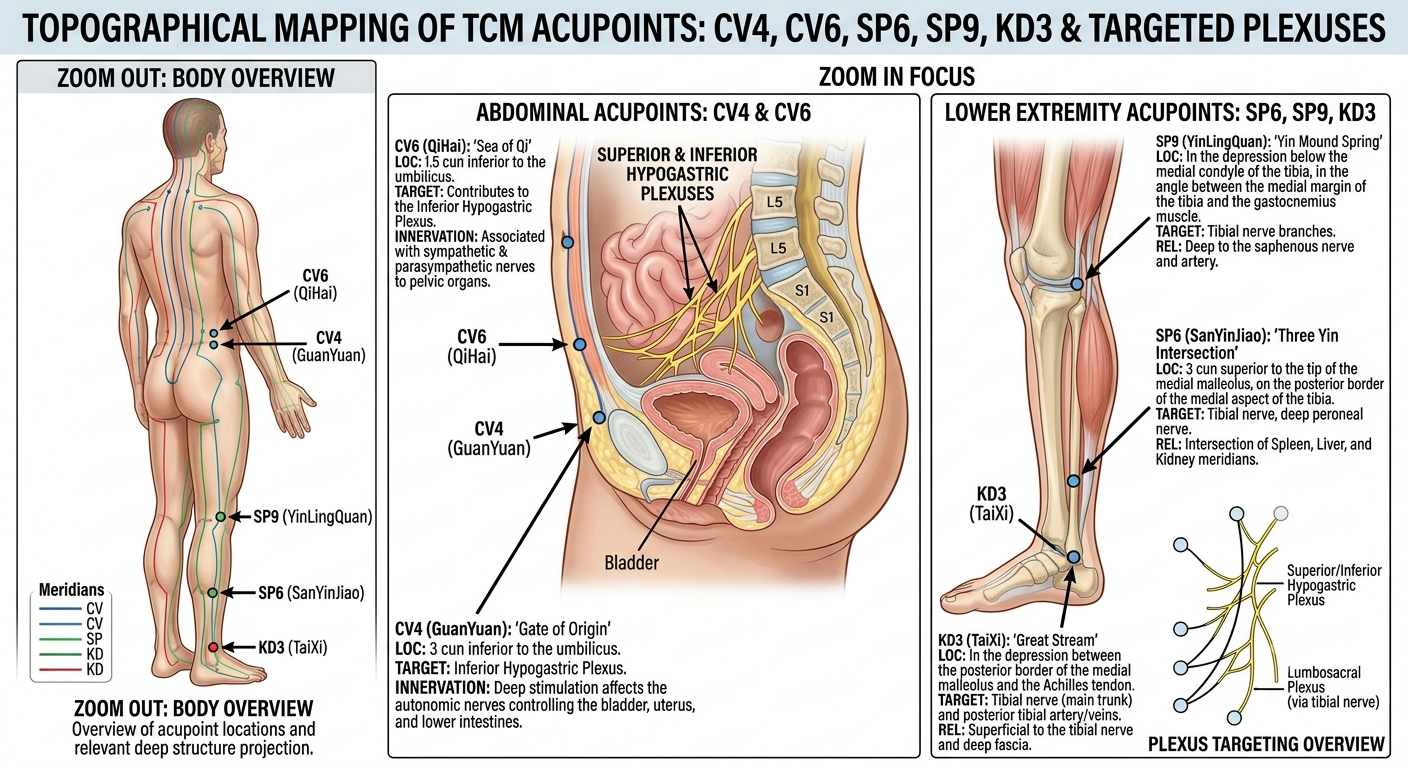 Figure 1: Topographical mapping of acupoints CV4 (Guanyuan) and CV6 (Qihai) targeting pelvic nerve plexuses. Going a step further, a multicenter randomized controlled trial by Zhang et al. (2025) isolated specific, high-impact regions on the lower abdomen. The study demonstrated that electroacupuncture at CV4 (Guanyuan) and CV6 (Qihai) provides targeted, physical relief. By introducing controlled electrical micro-currents to these specific points **CV4 (Guanyuan)** and **CV6 (Qihai)**, clinicians directly influenced the hypogastric nerve network and observed measurable improvements in urinary stream and bladder emptying. The resulting regulation improves the detrusor muscle tone of the bladder, decreasing structural urinary retention and frequency, thus establishing acupuncture as a robust alternative to standard pill regimens. This localized efficacy is confirmed on a macro-scale by a extensive Systematic Review (2025) evaluating 7 clinical trials with 1,084 total participants. The meta-regression proved that acupuncture significantly optimizes the International Prostate Symptom Score (IPSS) and elevates overall Quality of Life (QoL) metrics over sham interventions with a Standardized Mean Difference (SMD) of **-0.72**. 3. Herbal Intracellular Mechanisms and Volume ReductionWhile electroacupuncture restores functional flow, classic internal medicines treat structural tissue hyperplasia. A retrospective cohort study (n=187) published in the Chinese Journal of Andrology by Liu, H. et al. (2024) analyzed the therapeutic impact of the classic formula **Jin Gui Shen Qi Wan**. 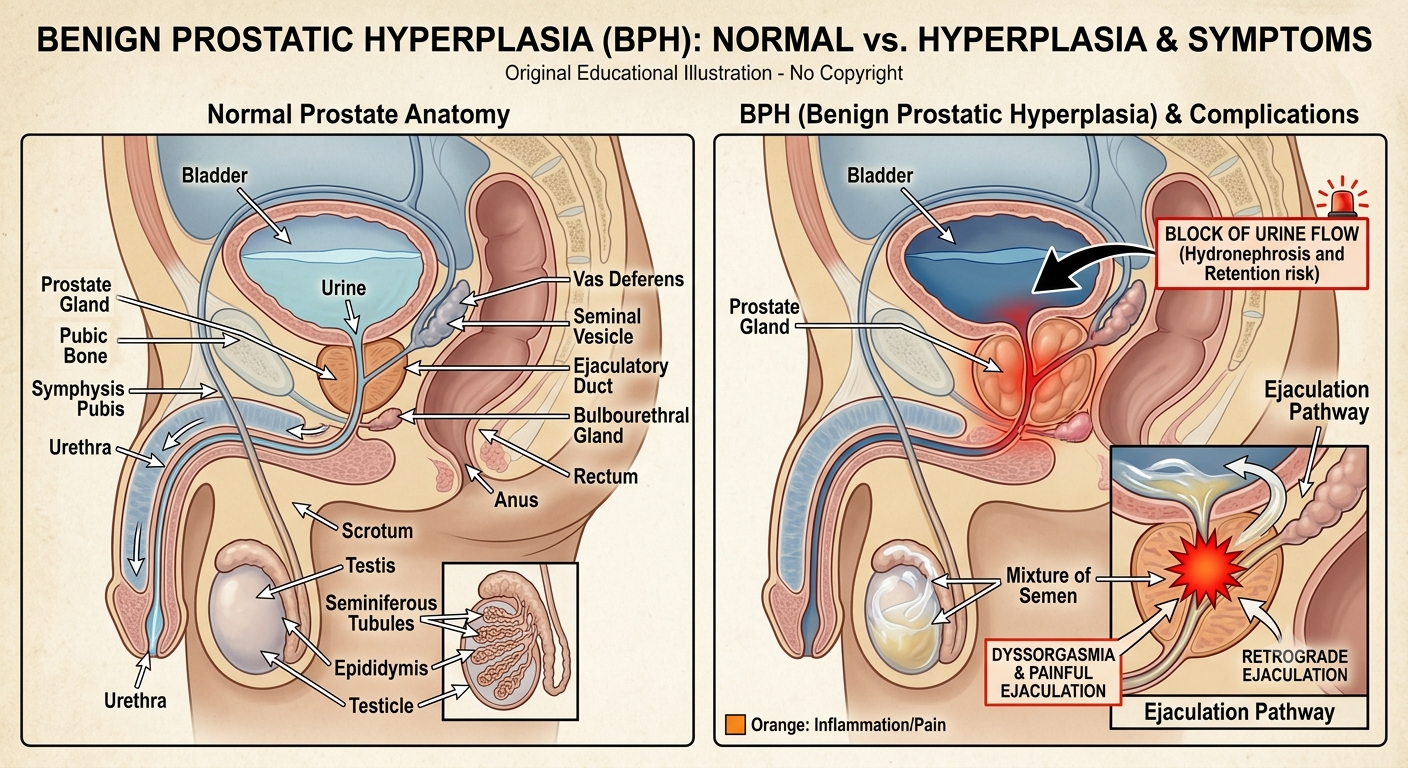 The trial results indicated verifiable long-term physical containment of the condition, documenting a structural reduction in overall prostate volume among elderly patient groups. This down-regulation bypasses the complete systemic shutdown of testosterone, maintaining normal baseline cellular homeostasis. Biochemical Pathways Identified in Jin Gui Shen Qi Wan
4. Comparative Safety Analysis: The Orthostatic Fall SolutionThe defining differentiator of traditional paradigms is synthesized in the meta-analysis conducted by Wang, Y. (2026) in Frontiers in Pharmacology. Evaluating 15 randomized controlled trials, the safety profile of TCM formulas was benchmarked directly against modern synthetic alpha-blockers. While alpha-blockers routinely trigger system-wide vascular dilation, leading to orthostatic blood pressure drops and subsequent vertigo, the TCM groups recorded an incidence rate of **0.0% for orthostatic hypotension**. This safety ceiling significantly minimizes fall risks, marking a crucial evolution in specialized geriatric medicine. |
5. Clinical Conclusion & Implementation Summary
The synthesized trials confirm that traditional modalities are no longer just complementary options; they provide a primary treatment pathway. For mild-to-moderate configurations of BPH, combining **electroacupuncture (CV4/CV6)** and pharmacological-grade formulations like **Jin Gui Shen Qi Wan** offers the exact therapeutic efficacy of conventional alpha-blockers. By preserving hemodynamic stability and completely mitigating orthostatic drops, this approach delivers an advanced, high-safety baseline optimized for geriatric care.
- Log in to post comments